If you are comparing metal roof options, one specification can look backward at first: what gauge is metal roofing, and why does a smaller number mean a thicker panel? For steel roofing, common residential gauges include 24, 26, and 29 gauge. In simple terms, 24-gauge steel is thicker than 26-gauge, and 26-gauge is thicker than 29-gauge.
The right choice is not simply “thicker is better.” The panel profile, roof design, decking, wind exposure, snow load, appearance, and manufacturer requirements all influence which gauge makes sense. At Chase Construction North West, Inc., we install metal roofing systems throughout the Puget Sound region and match the material and panel system to the needs of each property.
The Main Points To Know Before Choosing A Gauge
- A lower gauge number means thicker steel.
- 24 and 26 gauge are common choices for standing seam roofing.
- 29 gauge is thinner and is often used where the panel design and supporting structure allow it.
- Thicker metal generally offers greater rigidity and resistance to dents and installation damage.
- Gauge alone does not tell you whether a roofing system is suitable for your building.
- Compare the actual panel thickness, metal type, coating, profile, and tested roofing system before making a final decision.
How Steel Gauges Work
Metal gauge is a traditional way of describing sheet thickness. Unlike many measurement systems, the numbers move in the opposite direction. As the gauge number drops, the steel gets thicker.
The Metal Roofing Alliance installation manual highlights another detail that is easy to miss: the same gauge number does not necessarily represent the same thickness across different metals. For example, 24-gauge uncoated steel is nominally about 0.0239 inches thick, while other metals can have different dimensions at the same gauge number.
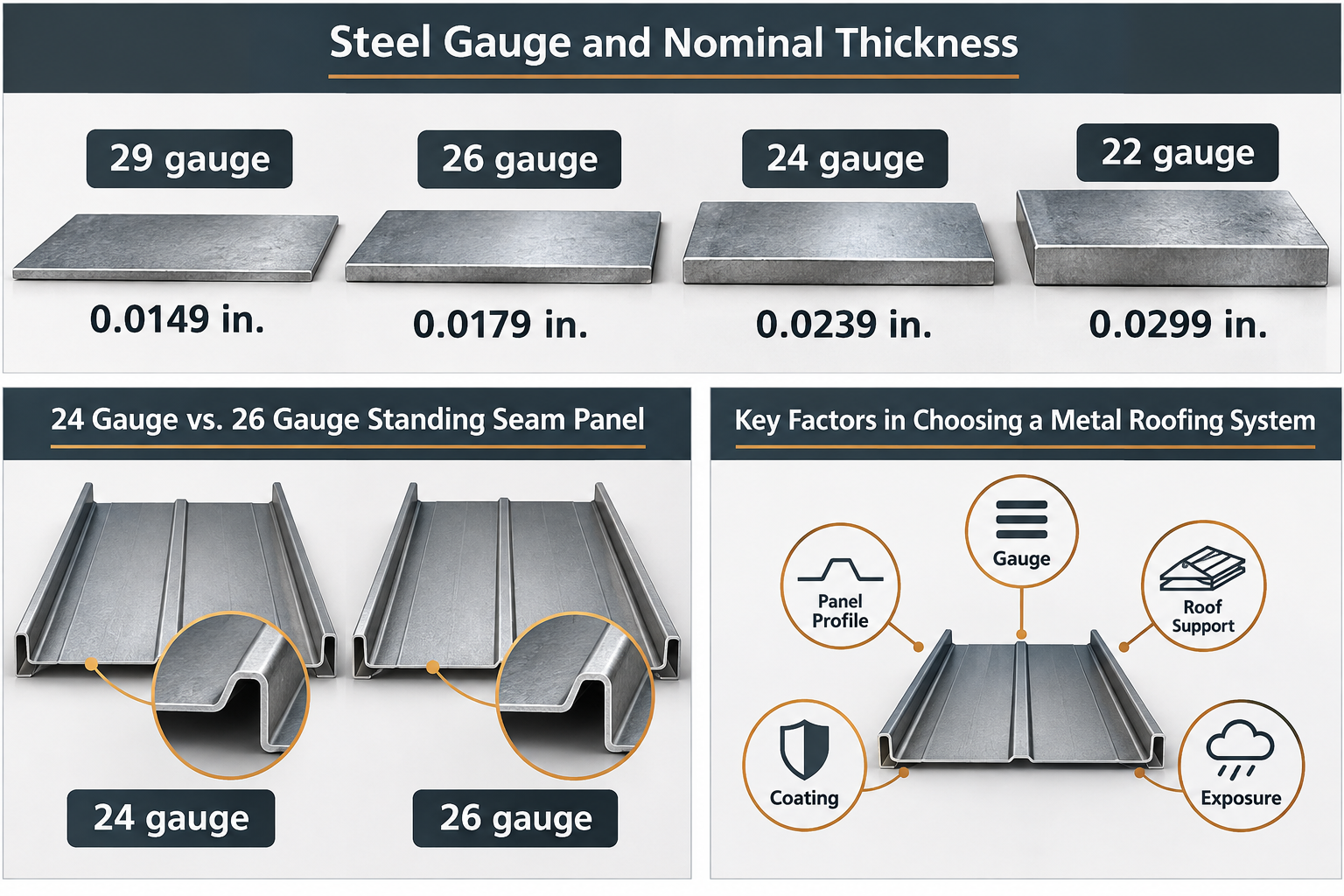
For that reason, a useful gauge chart for steel looks approximately like this:
| Steel Gauge | Approx. Nominal Thickness | General Roofing Context |
|---|---|---|
| 29 gauge | 0.0149 in. | Lighter-duty panels and some residential or agricultural systems |
| 26 gauge | 0.0179 in. | Common residential and commercial roofing |
| 24 gauge | 0.0239 in. | Standing seam and more demanding applications |
| 22 gauge | 0.0299 in. | Heavy commercial or specialized applications |
These are nominal steel thicknesses. The exact material supplied for a project should always be checked against the manufacturer’s specification because substrate, metallic coating, tolerances, and roofing system can affect the finished product.
Practical Tip: Do not compare two bids by gauge number alone. Ask for the metal type, actual thickness, panel profile, coating, and complete roofing system.
What Gauge Is Metal Roofing On A Typical Home?
There is no single required gauge for every house. In residential metal roofing, 24-, 26-, and 29-gauge steel are all available, but they are not interchangeable for every panel or roof.
A 26-gauge panel often provides a practical balance of rigidity, weight, and cost. A thicker 24-gauge panel is frequently associated with standing seam systems, demanding architectural applications, and projects where additional rigidity is useful.
The Metal Roofing Alliance’s material guidance also shows why steel is only one part of the decision. Galvanized steel, metallic-coated steel, aluminum, copper, and zinc behave differently, particularly when corrosion exposure becomes important.
Where Gauge Matters Most
A thicker panel can be valuable when the roof has large flat areas, demanding exposure, or a design where additional rigidity is beneficial.
One practical difference is dent resistance. Hail does not affect every metal panel in the same way because hail size, hardness, speed, panel support, and material all play a role. The National Roofing Contractors Association’s technical guidance notes that sufficiently energetic hail can dent or even damage metal roofing materials.
Gauge can also influence how a panel looks. Broad flat sections of metal sometimes develop visible waviness known as oil canning. The Metal Construction Association’s guidance on oil canning explains that the appearance can be influenced by factors such as panel width, material thickness, fabrication, and installation.
Thinner gauges may make waviness more noticeable in some applications, but simply moving to a thicker gauge cannot guarantee that oil canning will never occur.
Worth Knowing: Panel width matters too. A wide, flat standing seam panel may show movement or waviness differently from a narrower or striated panel made from the same gauge steel.
Why Panel Thickness Is Not The Only Specification That Matters
Choosing a roofing gauge without considering the rest of the system can lead to the wrong conclusion.
Start with the panel profile. Standing seam panels use concealed attachment systems, while exposed-fastener panels operate differently. Panel ribs and forming add stiffness, so two panels made from the same gauge steel can perform differently.
Next, consider what supports the panel. Solid roof decking and panels spanning between structural supports create different loading conditions. Manufacturer span tables, fastening requirements, wind-uplift testing, roof slope, and local building requirements should determine what is acceptable for the project.
The coating matters as well. A properly selected metallic coating and paint system protects steel against corrosion and weather exposure. In the wet Pacific Northwest, that complete assembly can matter just as much as moving from one gauge to another.
This is why asking only what gauge is metal roofing does not give you enough information to choose a roof. The better question is: what panel system, thickness, coating, and installation specification are right for this particular building?
How 24 Gauge And 26 Gauge Compare In Real Projects
The difference between 24 and 26 gauge is relatively small when measured in fractions of an inch, but it can make a noticeable difference in rigidity.
Thicker gauges are generally more resistant to bending during handling and installation. That additional stiffness may also be useful on roofs with broad flat panel areas or demanding exposure conditions.
However, thicker material also costs more. If a properly engineered 26-gauge roofing system already satisfies the requirements of a home, moving to 24 gauge purely because it is thicker may add cost without providing a meaningful benefit for that specific project.
Panel gauges should therefore be selected as part of the entire roof design rather than as an isolated upgrade.
Standing Seam Roofing And Gauge Selection
Standing seam metal roofing commonly uses 24- or 26-gauge steel. Because fasteners are concealed beneath the panel system, standing seam roofing can provide a clean architectural appearance while allowing the metal to respond to temperature changes.
Panel width also matters. Wider standing seam panels contain more flat metal between seams, which can influence rigidity and visible movement. Narrower panels or panels with pencil ribs and other stiffening features can behave differently even when the roofing gauge remains the same.
This is one reason experienced contractors look beyond a simple gauge chart when recommending a system.
Real Metal Roofing Projects In The Puget Sound
Gauge selection becomes easier to understand when you look at actual installations.
Chase Construction North West has installed different panel gauges depending on the roofing system and project. On a Tacoma metal roofing project, the team installed NuRay Metals Series 6000 standing seam roofing using 24-gauge, 16-inch pencil-ribbed panels. The company has also used 26-gauge, 16-inch pencil-ribbed NuRay standing seam panels on other residential projects.
That difference matters. A professional recommendation should start with the structure, panel system, exposure, desired appearance, and manufacturer specifications rather than automatically prescribing the thickest available metal.
Chase Construction North West provides metal roofing services for residential and commercial properties, including standing seam, corrugated, tuff rib, and other metal roofing systems throughout the Puget Sound region.
Choosing The Right Metal Roofing System With Chase Construction North West
When homeowners compare steel gauges, it is easy to focus on one number and overlook the rest of the roof. Chase Construction North West evaluates the complete roofing system, including the structure, panel profile, material, fastening method, flashing, ventilation, and conditions the roof will face.
That is especially important in Western Washington, where prolonged moisture, seasonal storms, wind, and changing temperatures all affect roofing performance. The goal is not simply to install thicker metal. It is to select and install a system that makes sense for the property.
A professional inspection can also identify decking problems, flashing requirements, ventilation concerns, or structural conditions that should be addressed before the new metal panels are installed.
Why Choose Chase Construction North West
- Family-owned roofing company established in 2002.
- Licensed, bonded, and insured Washington roofing contractor.
- More than 30 years of roofing experience within the family business.
- Experience with residential and commercial metal roofing systems.
- Involvement with professional roofing organizations, including the National Roofing Contractors Association and Roofing Contractors Association of Washington.
- Extensive experience with standing seam and other metal roofing applications across the Puget Sound region.
You can learn more about the company’s background and qualifications on the Chase Construction North West about page.
Choose The Right Metal Roof For Your Property
If you are planning a metal roof in Tacoma, Seattle, Puyallup, Auburn, Kent, Bellevue, Edgewood, Olympia, or elsewhere in the Puget Sound region, the best starting point is an evaluation of the entire roofing system rather than choosing a gauge from a chart.
The team can review your roof, discuss panel profiles and steel gauges, and explain which options make sense for your property and budget. Get in touch for a roofing estimate to discuss a metal roofing system suited to your property and Pacific Northwest conditions.
Frequently Asked Questions
Is 24 Or 26 Gauge Better For Metal Roofing?
Neither is automatically better for every roof. A 24-gauge panel is thicker, while 26 gauge can provide an effective balance of strength and cost when the roofing system is designed for it.
The right choice depends on the panel profile, roof structure, exposure, manufacturer requirements, and overall project specifications.
Is 29-Gauge Metal Roofing Too Thin For A House?
Not necessarily. A properly designed 29-gauge system may be suitable for certain residential applications.
Panel profile, decking, span, wind requirements, attachment method, and manufacturer specifications should all be checked before selecting it.
Does A Lower Metal Gauge Mean Thicker Metal?
Yes. Metal gauge numbers work in reverse, so 24-gauge steel is thicker than 26-gauge steel, and 26 gauge is thicker than 29 gauge.
That is why the gauge number should never be interpreted like a normal thickness measurement.
What Gauge Is Metal Roofing For Standing Seam Systems?
Standing seam roofing is commonly available in 24- and 26-gauge steel.
The correct specification depends on the manufacturer, panel design, building structure, environmental exposure, and required performance.
Does Thicker Metal Stop Oil Canning?
No. Thicker gauges may improve panel rigidity, but they cannot completely eliminate oil canning.
Panel width, substrate condition, fabrication, handling, thermal movement, and installation practices can all influence visible waviness.
Should I Choose Metal Roofing Based On Gauge Or Price?
Neither should be considered alone. Compare the complete system, including gauge steel, actual panel thickness, profile, coating, fasteners, flashing, manufacturer requirements, installer experience, and warranty coverage.
Understanding what gauge is metal roofing is useful, but the best roof comes from matching all of those components to the specific project.